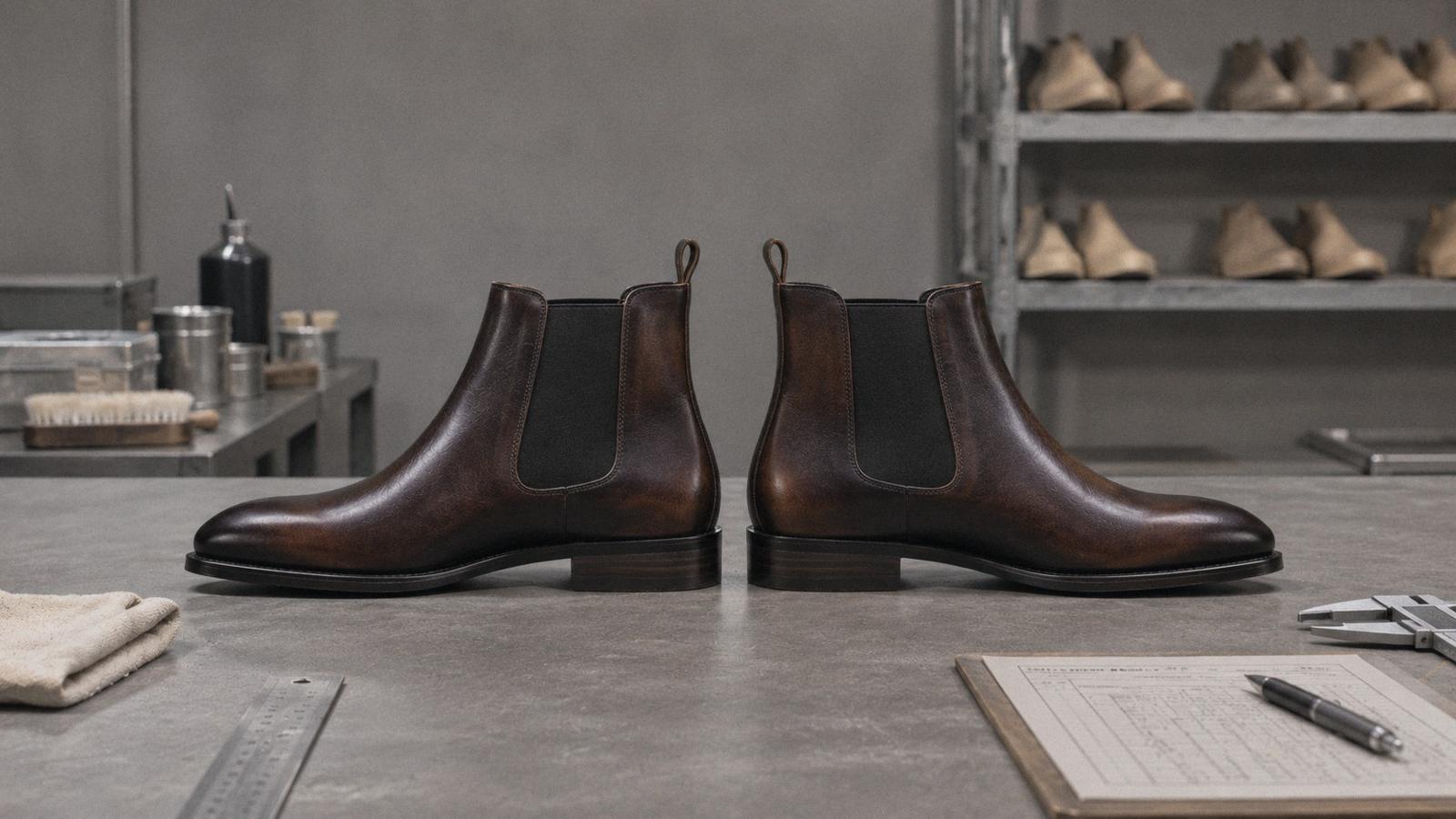
A pair of dark brown leather Chelsea boots facing each other on a quality-control bench Capabilities · Quality Control

The quality of a shoe lies in the harmony of its materials, construction and workmanship.

At ETOR, quality management is a continuous process, from translating the technical requirements defined during product development into bulk production through to the shipment of the finished product.

This page explains what our products are assessed against, the stages at which they are inspected, the action taken when a non-conformity is identified and the tests our materials undergo.

Our production principle

Whether or not our partner requests it, every material used in production undergoes independent laboratory analysis for carcinogenic and other harmful chemical substances as a matter of course.

Quality management system

Our manufacturing processes are run under an ISO 9001:2015 Quality Management System.

01 — Reference

Quality is measured against a shared reference point.

For quality control to be meaningful, the standard against which a product is assessed must be clearly defined before production begins.

That standard is set by two references approved by our partner at the end of product development: the approved sample and the technical specification. The approved sample is the physical benchmark; the technical specification sets out the material, measurement, workmanship and branding criteria in writing.

Every inspection described below is made against these two references, and they also determine whether a product is accepted.

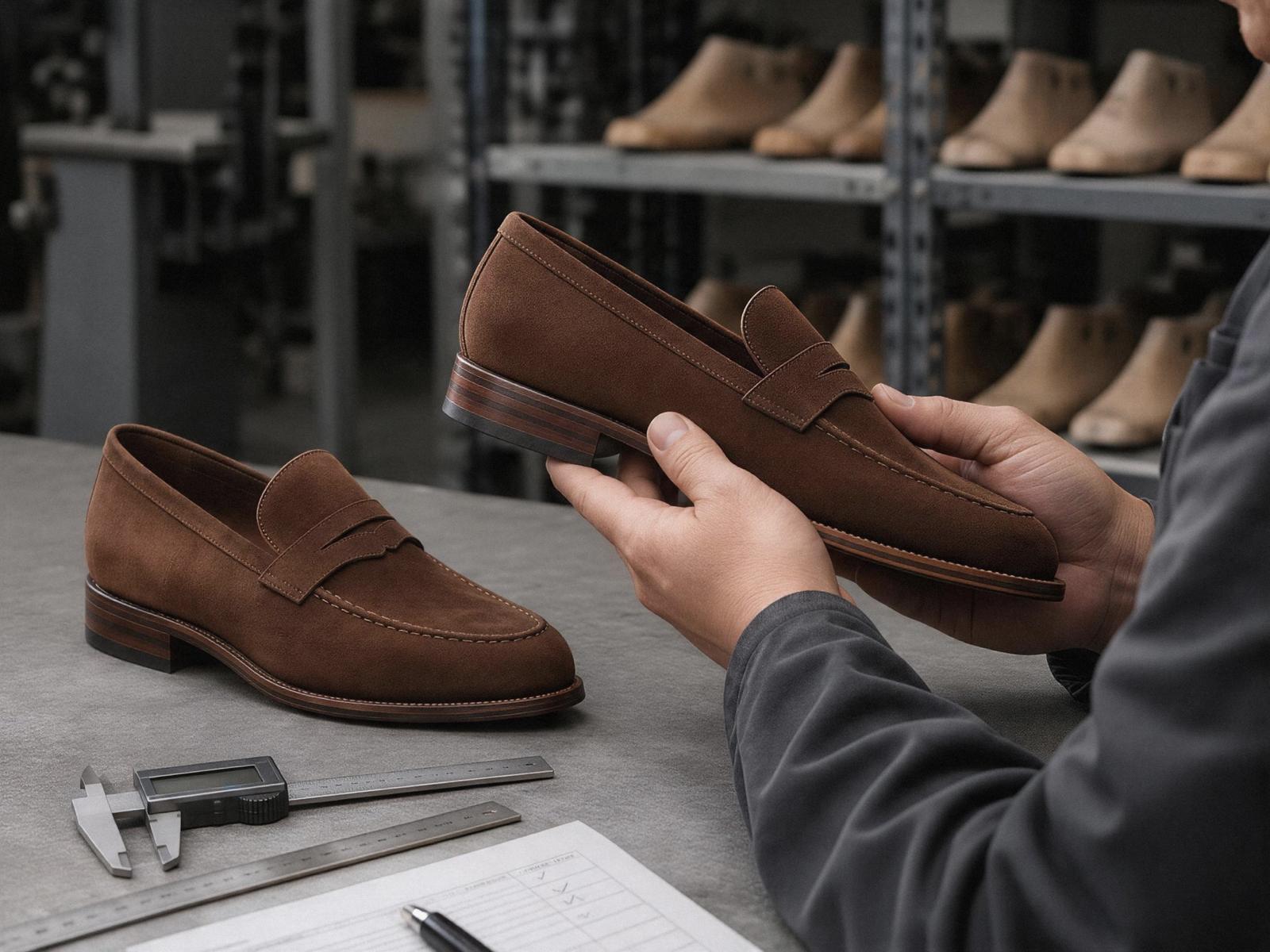
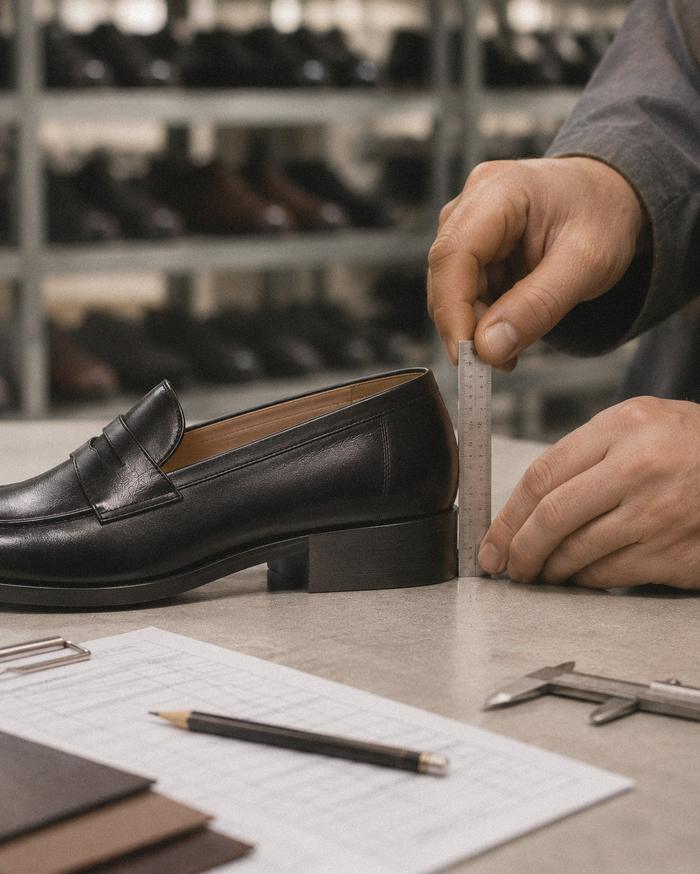
Comparing a bulk production pair with the approved sample
A pair from bulk production being checked against the approved sample

What the technical specification defines

01

Materials & components

Specifications for the upper, lining, insole, outsole, heel and ancillary components.

02

Last & construction

Last reference, model shape, pattern placement and assembly methods.

03

Measurements & tolerances

Size run, critical measurement points and permitted dimensional tolerances.

04

Workmanship & appearance

Stitching, surface characteristics, shape, finishing and application of trims.

05

Branding & packaging

Logo, labelling, product identification and order-specific packaging requirements.

Any changes requested during production are implemented only after their impact on the approved references has been assessed and with our partner's written approval.

02 — Inspection process

From materials to shipment, seven inspection points.

Our inspections are designed to detect any deviation from the approved model at the earliest possible stage. At each inspection point, the action to be taken if a non-conformity is found is defined in advance.

At the three stages marked in orange, materials or products proceed to the next step only once they meet the acceptance criteria.

Acceptance stageIn-line inspection
  1. 01 / 07

    Incoming materials

    Leather, lining leather, soles and trims are analysed at independent laboratories before purchase and checked against the approved sample.

    What we check
    • Thickness, surface character, flexibility and colour consistency of the upper leather
    • Dimensions, shape and colour of sole and heel components
    • Appearance of trims and how they match other components
    • Laboratory analysis results
    In case of non-conformity

    Material that fails to meet the criteria is not released to production and is returned to the supplier. If no equivalent material can be sourced, an alternative is submitted for our partner's approval.

  2. 02 / 07

    Cutting & component preparation

    Cut components are checked against the model reference; the natural variation in each hide determines the cutting direction and pattern placement.

    What we check
    • Conformity with the model reference and orientation marks
    • Colour, grain and surface match across visible components
    In case of non-conformity

    Any non-conforming component is set aside and recut from a matching area of the same hide.

  3. 03 / 07

    Closing

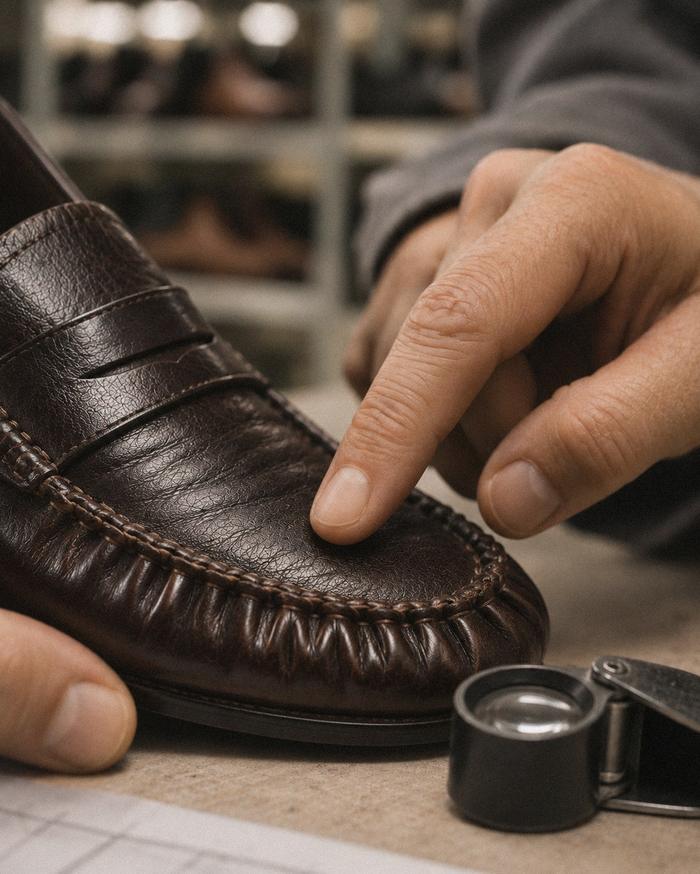
    Each upper is checked against the approved sample, both for appearance and for its readiness for lasting.

    What we check
    • Component joins and the placement of stitch lines
    • Edge finishing and lining placement
    • Application of trims and hardware
    In case of non-conformity

    Faulty stitching is unpicked and redone; where the leather has been damaged, the upper is remade.

  4. 04 / 07

    Lasting

    The way the upper meets the last determines the final shape of the shoe and its dimensional consistency.

    What we check
    • Fit of the upper on the last and distribution of tension
    • Toe and back-part shape
    • Symmetry and preparation for sole attaching
    In case of non-conformity

    Any upper that deviates in shape or symmetry is taken off the last and re-lasted.

  5. 05 / 07

    Sole attaching & finishing

    Sole attachment and surface finish are inspected according to the construction of each style.

    What we check
    • Sole positioning and bond lines
    • Conformity with the specified attaching method
    • Finish, colour and adhesive residue
    In case of non-conformity

    Surface flaws are corrected during finishing; any pair with a bonding defect is returned for rework.

  6. 06 / 07

    Final inspection

    The finished product is examined side by side with the approved sample, and the location and nature of any dimensional or visual deviation are identified. The sampling plan and acceptable quality level (AQL) are set according to order quantity and the contract agreed with the partner.

    What we check
    • Measurement and shape: last and size references, agreed tolerances
    • Pairing: shape, colour and trim placement across the left and right shoe
    • Workmanship and structural integrity: stitching, edge finishes, heel placement
    • Branding: logo, style code, size and label details
    In case of non-conformity

    Correctable variations are rectified and the product is re-inspected. Products that cannot be corrected are withheld from shipment and logged.

  7. 07 / 07

    Pre-shipment inspection

    Before dispatch, products, packaging and order details are cross-checked for consistency.

    What we check
    • Style, colour and size against the order
    • Left and right pairing
    • Product and box labels, branded packaging
    • Carton contents, quantities and shipping instructions
    In case of non-conformity

    Labelling, packaging or quantity discrepancies are resolved before dispatch; where the delivery schedule is affected, our partner is notified in writing.

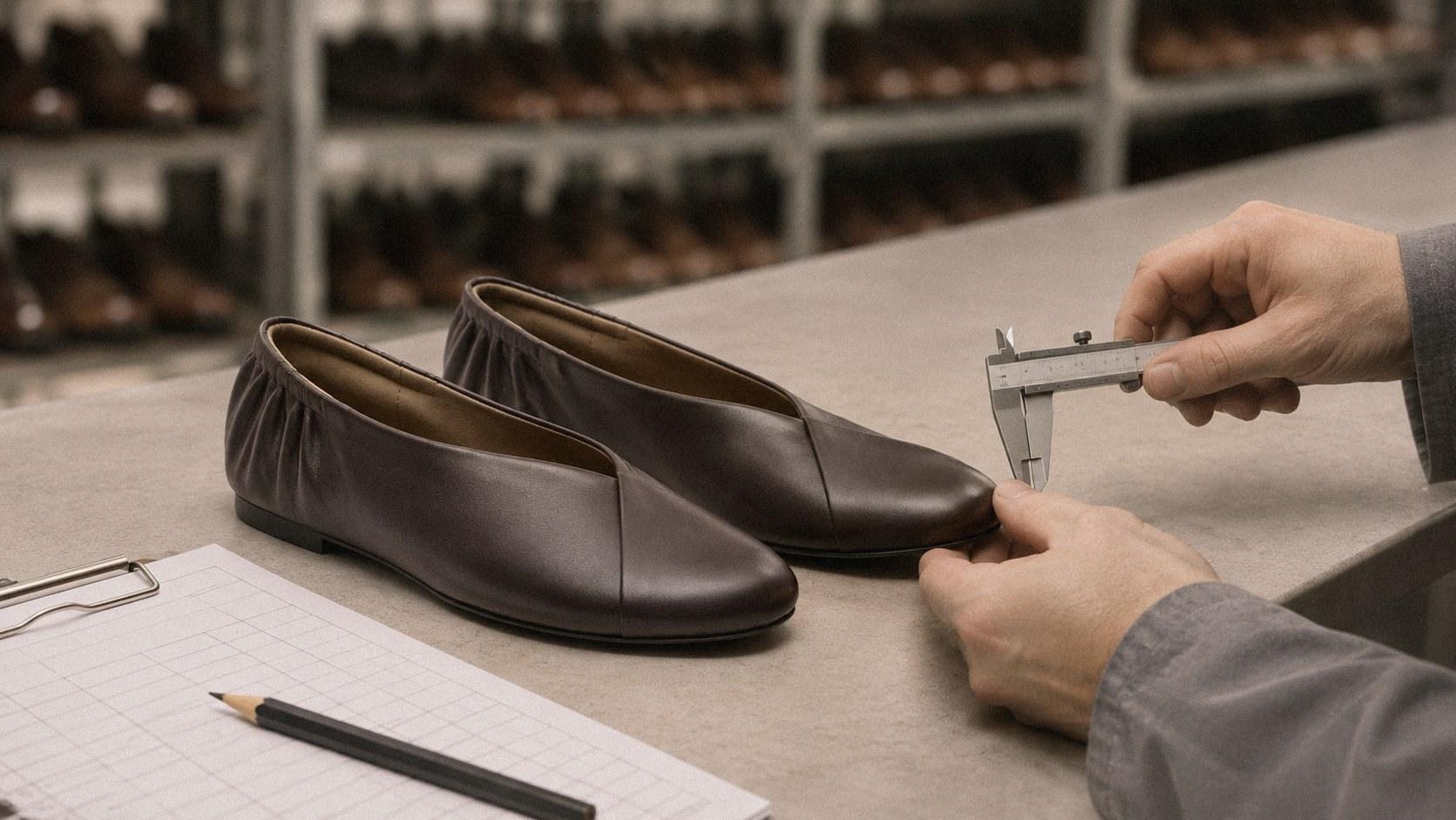
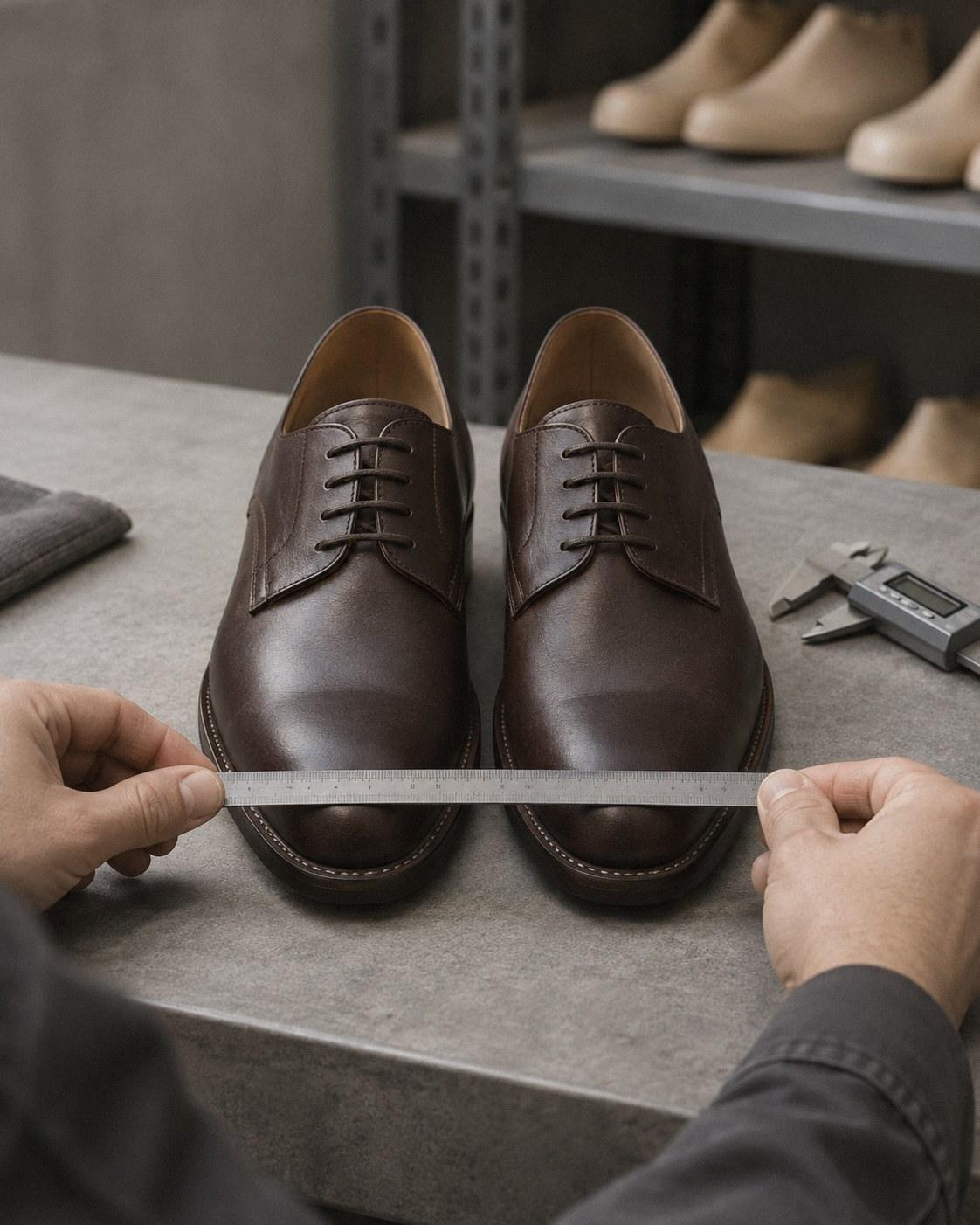
Shoes laid out on the quality control table
Ikitelli · Final inspection

03 — Managing non-conformities

Every deviation is handled according to its nature.

A cosmetic variation and a fault that compromises the structural integrity of a product do not carry equal weight. Non-conformities are classified according to how they depart from the approved references, and the response to each class is defined in advance.

ClassExampleAction

Cosmetic variation

Adhesive residue, finish shade, surface marks

Rectified on the product and re-inspected.

Dimensional or shape deviation

Out-of-tolerance measurements; deviation in symmetry or shape

Returned to the relevant stage for rework; the root cause is identified.

Structural non-conformity

Weak sole bond, material defect or any fault affecting fitness for purpose

Withheld from shipment; any potentially affected production lot is examined and our partner is notified in writing.

Natural variations in grain and surface character are intrinsic to genuine leather and do not, in themselves, constitute a non-conformity. They are controlled through cutting direction and component placement, with the appearance of the approved sample serving as the reference for assessment.

Assessment and decision

01

Identification

The location and nature of the variation are established by comparison with the approved sample.

02

Scope

We establish whether the same issue occurs in other products or elsewhere in the production lot.

03

Corrective action

The product is rectified, reworked or withheld, and the root cause is addressed.

04

Conformity decision

The product is re-inspected and its conformity with the acceptance criteria is formally determined.

Where a partner has its own non-conformity classification or acceptance procedure, the assessment is conducted on that basis.

Non-conformities reported after shipment are likewise examined against the approved sample and technical specification; the outcome of the assessment and the action to be taken are confirmed to the partner in writing.

04 — Laboratory testing

A method and a limit value define every test.

Before any material is purchased, it is analysed by independent laboratories for carcinogenic and hazardous chemicals. Every test follows an international method, and each result is measured against a defined acceptance limit.

Any material that exceeds the acceptance limit is barred from production.

The framework behind our testing

Regulation

REACH

Regulation on the Registration, Evaluation, Authorisation and Restriction of Chemicals. It applies to all products sold in the European Union, and Annex XVII sets the maximum concentrations of specific substances permitted in products.

What this means for partners: the brand itself is legally responsible for any product placed on the EU market. Compliance with REACH limits is a precondition for trouble-free market access.

Test methods

EN ISO standards

Methods published by the International Organization for Standardization (ISO) and the European Committee for Standardization (CEN). EN ISO 17075, for instance, specifies how the chromium VI content of leather is determined.

What this means for partners: results obtained by the same method are comparable from one laboratory to another, so any verification testing the brand commissions can be judged on the same basis.

Laboratory competence

TURKAK · ISO/IEC 17025

ISO/IEC 17025 is the international standard for the technical competence of testing laboratories. The Turkish Accreditation Agency (TURKAK) assesses laboratories against this standard and grants accreditation.

What this means for partners: under international mutual recognition arrangements, a report from an accredited laboratory is equally valid abroad.

Industry list

RSL · AFIRM

Restricted Substances List. The AFIRM RSL is a shared list compiled by international apparel and footwear brands; it also recommends reference values for substances that regulation does not limit.

What this means for partners: where a brand has its own RSL, testing is planned against it.
Testing

Test 01

Chromium VI

Hexavalent chromium · Cr(VI)

Acceptance limit< 3 mg/kgEU REACH Annex XVII, entry 47
Why
Can form in chrome-tanned leather depending on processing or conditions of use, and may cause allergic contact dermatitis.
Method
EN ISO 17075-1 (colorimetric) or EN ISO 17075-2 (chromatographic)
Measured
Cr(VI) extractable from the leather sample, expressed on a dry-weight basis
Applies to
Upper, lining and insole leathers
Test 02

Azo dyes

Restricted aromatic amines

Acceptance limit≤ 30 mg/kg per amineEU REACH Annex XVII, entry 43
Why
Certain azo dyes break down into aromatic amines known to be carcinogenic.
Method
EN ISO 17234-1; reductive cleavage followed by GC-MS or HPLC analysis
Measured
Each of the 22 restricted aromatic amines, individually
Applies to
Dyed leather, leather linings and laces
Test 03

Formaldehyde

Free and hydrolysed formaldehyde

Acceptance limit≤ 75 mg/kg in products in contact with skinIndustry reference: AFIRM RSL
Why
May derive from chemicals used in leather processing and adhesives; can irritate the skin and respiratory tract.
Method
EN ISO 17226-1 (HPLC)
Measured
Formaldehyde extracted from the sample
Applies to
Leather and leather components
Test 04

Phthalates

DEHP, DBP, BBP, DIBP

Acceptance limitTotal ≤ 0.1% by weightEU REACH Annex XVII, entry 51
Why
Used as plasticisers, these substances can disrupt the endocrine system.
Method
ISO 16181-1; solvent extraction and GC-MS analysis
Measured
Each of the four phthalates, individually and in total
Applies to
PVC and plastic components, soles, prints and coatings
Test 05

Dimethyl fumarate

DMFu

Acceptance limit≤ 0.1 mg/kgEU REACH Annex XVII, entry 61
Why
A biocide formerly used as an anti-mould agent during storage and shipping; even trace amounts can trigger severe allergic reactions.
Method
ISO 16186; GC-MS analysis
Measured
DMFu content of the material
Applies to
All components, and desiccants packed with the product
Test 06

Organotin compounds

DBT, DOT, TBT

Acceptance limitEach ≤ 0.1% by weight of tinEU REACH Annex XVII, entry 20
Why
Used as biocides and stabilisers, these compounds are toxic and can affect the immune system.
Method
ISO/TS 16179; derivatisation and GC-MS analysis
Measured
Content of each compound, expressed by weight of tin
Applies to
Plastic, rubber and coated components
Test 07

Heavy metals

Nickel release, lead, cadmium

Acceptance limitNickel ≤ 0.5 µg/cm²/week · Cadmium < 100 mg/kg · Lead < 500 mg/kgEU REACH Annex XVII, entries 27, 23, 63
Why
Nickel in metal trims can cause allergic reactions; lead and cadmium can damage health through prolonged exposure.
Method
Nickel: EN 1811 (release test in artificial sweat). Lead and cadmium: acid digestion and ICP-OES analysis
Measured
Nickel released from surfaces in contact with skin; total lead and cadmium content of the material
Applies to
Buckles, rivets, snap fasteners, zips and metal ornaments

The scope of testing is determined by material type and the requirements of the destination market. Test reports are available to partners on request.

The laboratories that carry out our testing

EKOTEKS logo

EKOTEKS Laboratory

Independent testing laboratory affiliated with IHKIB

Affiliation
An IHKIB affiliate within ITKIB (Istanbul Textile and Apparel Exporters' Associations)
Legal name
Ekoteks Laboratuvar ve Gozetim Hizmetleri A.S.
Founded
1998
Chemical testing
Carcinogenic and allergenic dyestuffs, azo dyes, chromium VI, formaldehyde, phthalates, heavy metals, nickel
TASEV logo

TASEV Laboratory

Accredited testing laboratory dedicated to the footwear industry

Affiliation
TASD (Footwear Industrialists Association of Turkiye) and the Turkish Footwear Industry Foundation of Research, Development and Education
Legal name
TASEV Laboratuvar ve Teknik Hizmetler A.S.
Founded · accreditation
2006 · TURKAK-accredited since 2007
Chemical testing
Phthalates, dimethyl fumarate (DMFu), dimethylformamide (DMF), organotin compounds; azo dyes, formaldehyde and metal content in leather

05 — Partner-specific standards

Every brand has its own expectations.

In private-label manufacturing, quality requirements can differ with each brand's product philosophy, target market and collection. They are clarified during product development and written into the technical specification.

A

Technical specifications

The partner's tech packs, bills of materials and style details are incorporated into the production references.

B

Measurement & appearance criteria

Critical measurements, tolerances, colour, surface characteristics and pairing can be defined project by project.

C

Performance testing

Physical, mechanical or chemical testing requirements can be specified according to intended use and target market.

D

Inspection & acceptance procedures

Inspection points, sampling methods and acceptance criteria may be defined by the partner, and inspections by independent bodies appointed by the partner are accepted.

E

Certification & reporting

The scope of quality records, test reports and certificates of conformity is set according to project requirements.

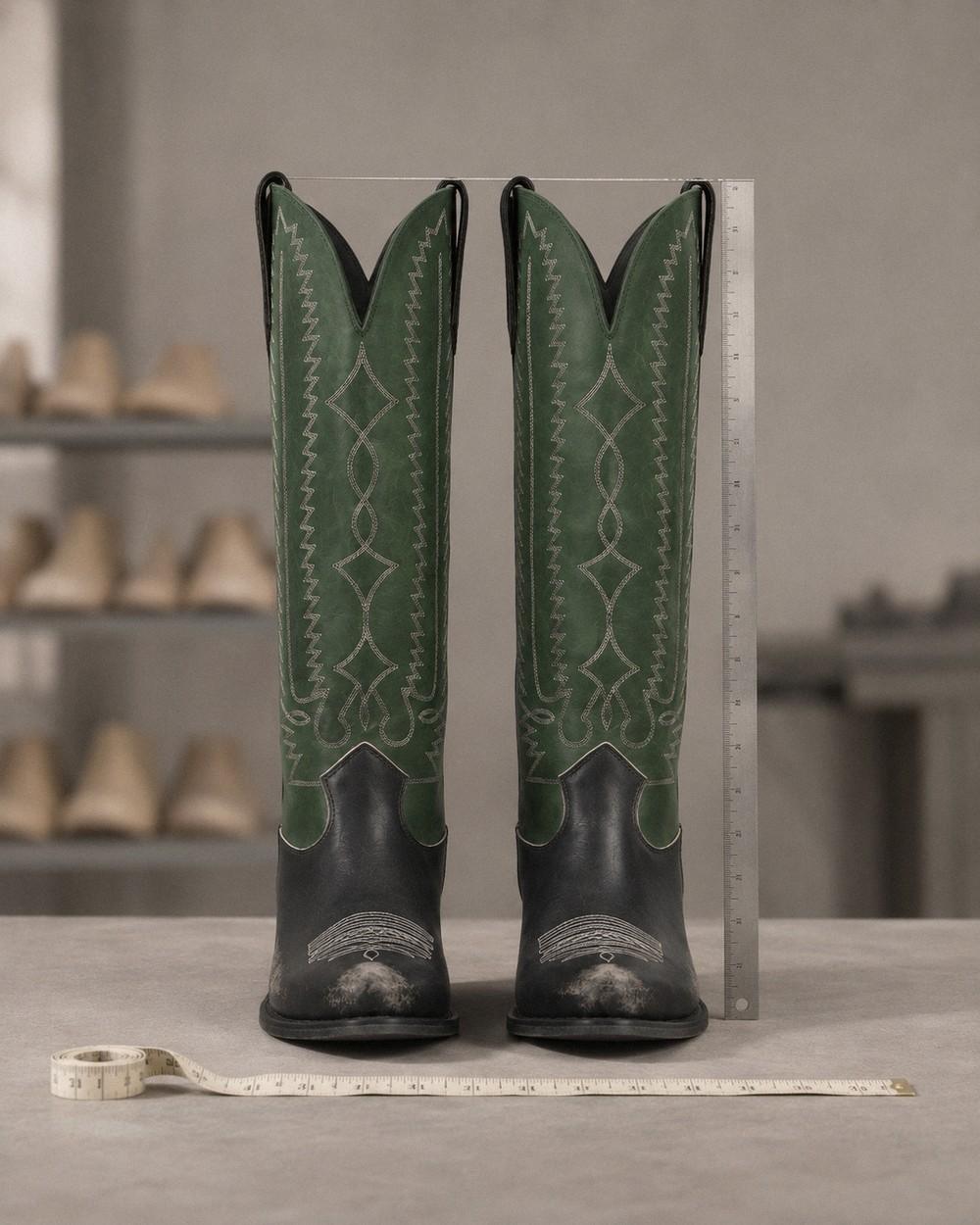
Western boot
06 — Additional checks for Western boots

Each pair is assessed as one unified whole.

Western boots are the most hand-crafted category in ETOR's range. With their tall shafts, expansive leather surfaces and multiple rows of decorative stitching, even the slightest difference between the two boots of a pair is plainly visible.

For this reason, Western boots undergo additional checks on the consistency of the pair, on top of the standard inspection points.

01

Leather matching

The upper components of each pair are cut from matching areas of the same hide, with grain and colour carefully aligned.

02

Stitch pattern

The placement, row spacing and symmetry of the decorative stitching on the shaft are compared across both boots.

03

Shaft and shape symmetry

Shaft height, top-opening width and the shape of the foot are measured as a pair before lasting.

04

Application of trims and hardware

Once applied by hand, metal trims are checked on each boot individually for position and security.

Measurement check
Stitching check
Pair matching check
ETOR · Est. 1988

Let us define your quality requirements together.

Your technical specification, quality acceptance criteria and project-specific testing requirements are reviewed together with you at the outset of production.

Get in touch →